America’s Promise
Our country is not held together by a common ancestry or a single inherited culture. It is held together, imperfectly, by shared civic and economic values—and by the promises those values make: that people from anywhere can belong, contribute, participate and build a better life.
These promises have never been fully or equally realized. But they have given generations of Americans a standard by which to demand inclusion and measure progress.
The ten Values below form an initial authored framework, intended to bring coherence and consistency to the Index's evaluations. They are not an exhaustive or permanently fixed account of everything Americans value.
The five Economic Values follow a connected promise:
Meet basic needs → Withstand setbacks → Advance through work → Build lasting wealth → Sustain opportunity for the future
Each Value has a governing question that asks whether its promise is being realized in Americans’ lives today.
Economic Values
Economic Dignity
Governing question: Is there a sufficient floor beneath people?
A prosperous society should enable people to meet their basic needs, avoid severe deprivation and receive effective protection when they cannot fully provide for themselves.
Resilience
Governing question: Can people maintain stability when ordinary hardships occur?
Economic stability means people should be able to meet regular expenses, prepare for unexpected costs and remain secure through temporary difficulties.
Job Opportunity
Governing question: Can people improve their lives through work?
Work should provide a meaningful path to economic contribution, financial independence and wealth building. People who want to work should be able to obtain sufficient and suitable employment that uses their abilities and supports a stable life.
Wealth Building
Governing question: How broadly can Americans build and retain wealth?
Economic progress should increase America’s wealth. As that wealth grows, the people contributing to greater prosperity should share in its gains and be able to preserve the wealth they build.
Stewardship
Governing question: Is America responsibly safeguarding future prosperity?
Stewardship requires responsibility toward future generations: confronting environmental threats to our security, using present resources wisely and investing in the knowledge and productive capacity they will need.
Freedom of Expression
Americans fundamentally believe they are free to express their ideas and beliefs. That freedom includes the practical ability to speak, challenge authority and participate in public life.
Governing question: In modern America, can people speak freely, challenge authority and participate in public debate?
Public standard: People can lawfully express ideas and beliefs without unjustified institutional suppression, intimidation or retaliation.
Democratic Participation and Political Citizenship
Political citizenship means that Americans possess meaningful agency over who governs them, how government acts and whether those in power remain accountable.
Governing question: How well does American democracy empower citizens to choose their leaders, shape their government and hold those in power accountable?
Public standard: Citizens can choose leaders, influence government, participate meaningfully and hold public power accountable.
Government Belongs to Every Faith—and No Faith
Government belongs equally to Americans of every faith and no faith.
Governing question: Does government preserve equal civic standing for Americans of every faith and no faith, without using public power to impose, privilege or enforce particular religious beliefs?
Public standard: Government neither imposes religious observance, privileges one faith nor conditions public standing or benefits on adherence, while religious citizens and organizations retain full democratic rights.
Capable Self-Government
Americans have long placed faith in the promise that self-government can address shared problems and improve people’s lives.
Governing question: Do government and public institutions have the ability and will to address established public problems, respond meaningfully to the people they serve and improve American lives?
Public standard: Public institutions recognize established problems, respond meaningfully, use their capacity responsibly, correct known vulnerabilities and improve people’s lives.
Merit versus Concentrated Power
The American promise is that merit, talent and personal responsibility should matter more than wealth, connections and political power.
Governing question: Does America reward merit, talent and personal responsibility more than wealth, connections, and political power?
Public standard: Access, opportunity, rules, public decisions, benefits, burdens and accountability should not be distorted primarily by concentrated wealth, connections or political power.
Civic Values
The five Civic Values ask whether Americans possess meaningful freedom, genuine political agency, equal standing, capable institutions and fair opportunity.
Methodology
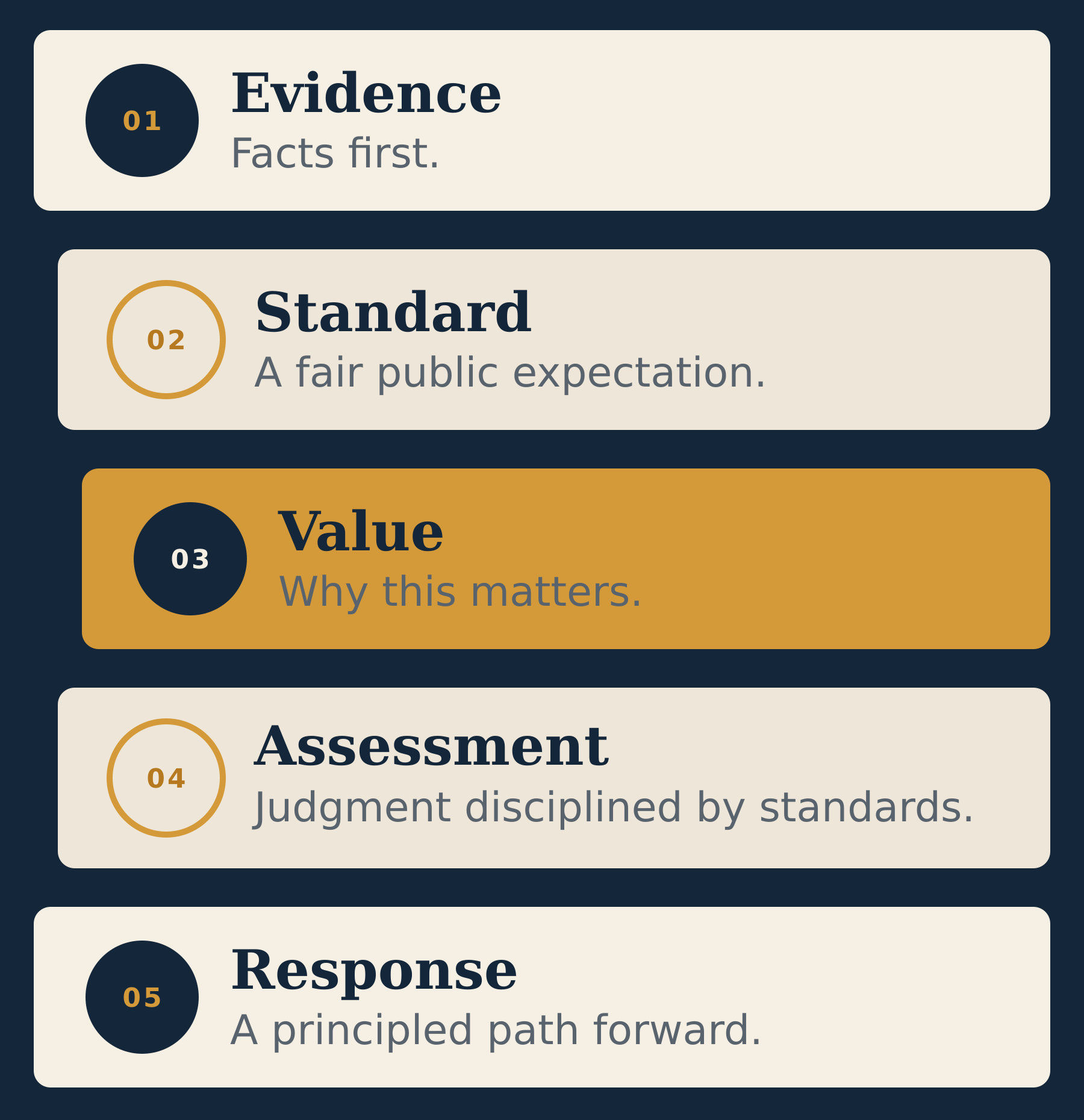
Methodology explains how US Values Index evaluates whether America is living up to a Value by answering three questions:
What evidence does US Values Index use?
What Standard is that evidence judged against?
How does US Values Index reach—and limit—its conclusion?
A civic + economic framework to examine the American promise.
This sequence shows how readers encounter a published assessment.
Two forms of evidence
Economic evaluation begins with the strongest relevant, reliable and recurring public data available. Civic evaluation begins with a substantiated public record of events, decisions, institutional conduct and their consequences for Americans’ practical freedom and democratic agency.
The methods differ because the questions differ.
Authored judgment
Standards do not replace the founder’s judgment; they discipline it. US Values Index assessments apply declared public standards to evidence. They are reasoned, transparent judgments—not claims of perfect neutrality.
Methodological restraint
The initial measures do not capture every dimension of a Value. They identify what can be responsibly assessed now. Where evidence is incomplete, US Values Index limits its judgment and states what the evidence cannot establish.
Economic measures may be added, replaced or retired transparently as the evidence base improves. Civic coverage requires credible evidence, a meaningful connection to a declared Value and sufficient significance to warrant assessment.